Chapter 8
The Project Canvas: How Each Initiative Is Structured
Part III — The Project Layer
Every AI project in the framework carries a single working document called the project canvas. The canvas is the artifact that holds the project together — what it is, how it will run, and what could go wrong with it. It is the place where the hypotheses-then-hardening principle from Chapter 2 actually lives. At the start of a project the canvas is lightly sketched: provisional answers, written down knowing they are partly wrong. As the project runs, the canvas hardens — answers sharpen, blanks fill in, mistaken assumptions get corrected. By the time a project graduates or shuts down, its canvas tells the story of what was learned.
This chapter introduces the canvas as a structure. The next three chapters expand each of its three sections in turn.
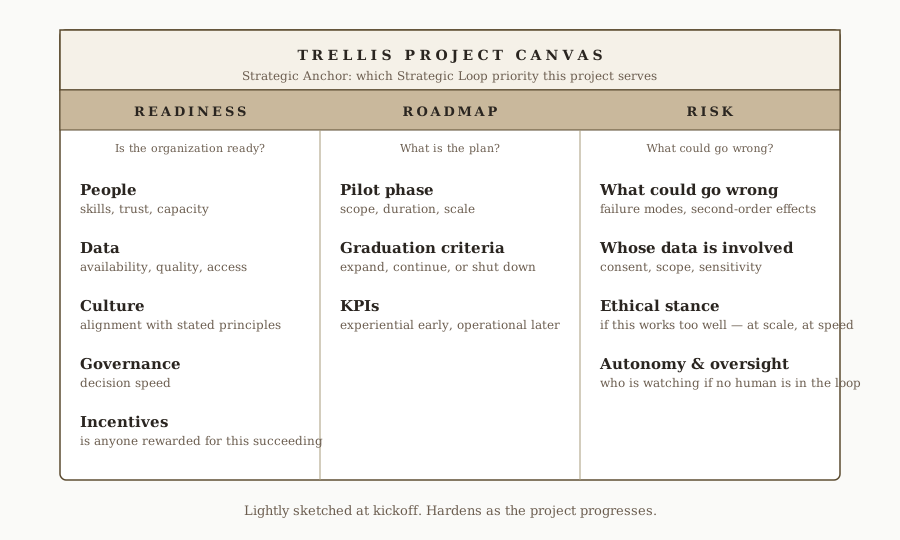
What the canvas covers
The canvas has three sections. Each one answers a different question.
Readiness asks: is the organization ready to run this project? Five dimensions get assessed — people, data, culture, governance, incentives — each one capable of derailing the project if it is missing. Chapter 10 walks through each in detail.
Roadmap asks: what is the plan? It covers the early pilot phase, the graduation criteria that determine whether the project moves forward or shuts down, and the KPIs that get tracked along the way. The KPIs themselves change shape as the project matures — experiential at first, operational later. Chapter 11 walks through the roadmap.
Risk asks: what could go wrong, and how will we know? Four day-one questions get answered: what could go wrong, whose data is involved, what is the ethical stance if this works too well, and who is watching if it runs autonomously. The answers start short and get more substantive as the project scales. Chapter 12 walks through each question.
The canvas also carries a strategic anchor at the top — a single sentence stating which priority from the Strategic Loop this project serves. The anchor is the project’s connection to the layer above. Without it, the project is unmoored, no matter how well the rest of the canvas is filled in.
A working document, not a deliverable
The canvas is not a one-time planning artifact. It is a living document that gets revised every time the project learns something new. A discovered data quality issue updates the readiness section. A clarified KPI updates the roadmap section. A newly-surfaced ethical concern updates the risk section. The canvas is meant to change as the project runs.
This is what makes the canvas distinct from the strategic deck or project charter that most organizations write at the start of an initiative. Those documents are written once, presented once, and then quietly archived as the project drifts away from them. The canvas is the opposite: it is meant to be revised. A canvas that has stopped changing is either a project that has stopped learning or a project that has stopped running.
The canvas is also intentionally short. The whole thing fits on a single page or screen. Each section is sketched in just enough detail to be evaluable — not deeply specified, not exhaustively analyzed. The discipline is to keep it sketched lightly enough that revising it is cheap, and specific enough that anyone looking at it can tell what the project actually is.
How projects enter the system
Projects come from two directions, and both flow through the same canvas once they are in motion.
The first kind is strategic. These are projects identified through the work in Part II — opportunities surfaced from the strategy, evaluated against the Strategic Loop, and prioritized for execution. They enter the canvas with a clear strategic anchor because they were chosen from the strategy in the first place.
The second kind is emergent. These are projects that surface from front-line experimentation, employee curiosity, or the unexpected discovery that a workflow could be reshaped by a tool someone tried over the weekend. They are not pre-planned. They become candidates for the canvas only by clearing the same strategic alignment test strategic projects already passed: does this serve a priority in the Strategic Loop, and how will we know if it does? The Forge (Chapter 9) is where this test happens — for both strategic and emergent projects. An emergent finding that cannot make the case for strategic relevance stays as team-level experimentation, which is healthy and welcome; it just does not consume institutional resources. A finding that clears the test enters the canvas alongside strategic projects, and the framework treats it the same way from that point forward.
Both kinds run through the same structure once they are in motion. The canvas does not distinguish between them. The point of the same canvas for strategic and emergent projects is to make them comparable — so the organization can talk about its full project portfolio in a single language, regardless of where individual projects originated.
The canvas in operation
Once a project has a canvas, the canvas is the artifact that gets reviewed at every checkpoint. Project reviews look at recent updates to the readiness section. Portfolio reviews compare canvases across projects to surface patterns. Strategy reviews aggregate evidence from all active canvases to update the Strategic Loop. The cadences for these reviews are described in Part V; what matters here is that the canvas is the unit of evidence at each level.
This is how the architecture from Chapter 3 actually functions in practice. The canvas is the unit of evidence the Project Layer produces. Patterns surface through it. Strategy revises through it. Policy hardens out of it.
The next three chapters take each section of the canvas in turn — readiness in Chapter 10, roadmap in Chapter 11, risk in Chapter 12.