Chapter 3
The Three-Layer Architecture: An Overview
Part I — Foundations
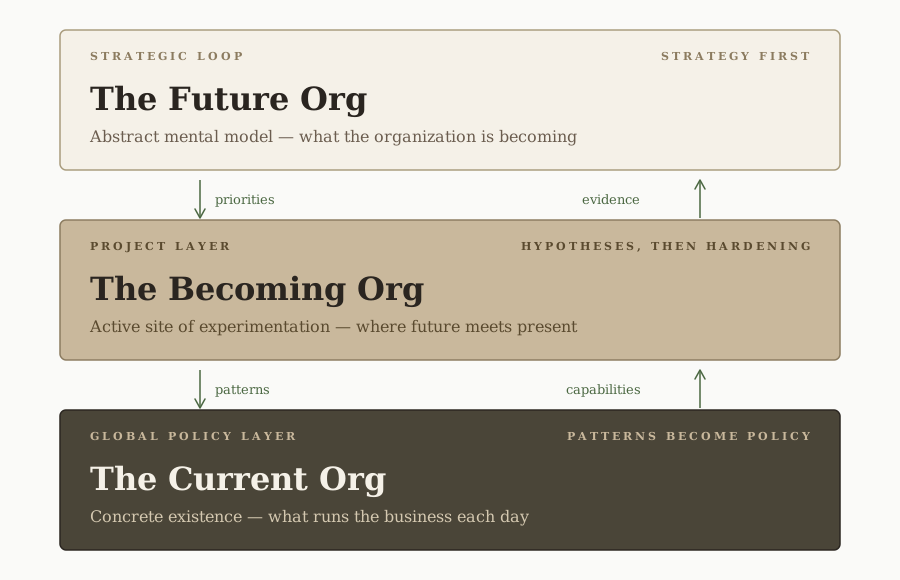
The three operating principles describe a way of working, not a structure. To turn the principles into something an organization can actually operate, you need a structure that holds them in place — somewhere strategy lives, somewhere projects run, somewhere policy accumulates. The framework organizes this into three layers stacked vertically: the Strategic Loop at the top, the Project Layer in the middle, and the Global Policy Layer at the bottom. This chapter introduces all three at once and explains the conceptual logic that holds them together. Subsequent parts of the document expand each layer in turn.
The two organizations every company is
Before the three layers make sense, one observation has to land. Every organization is two organizations at once.
There is the organization leadership talks about — what the company is becoming, where it is heading, what kind of business it intends to be in three or five years. This is the future org. It exists in conversations, in board decks, in strategy documents. It is abstract. It is aspirational. It is, in some sense, fictional — not yet real.
Then there is the organization that actually shows up to work each day. The standing structures, the people in their roles, the systems that hold the data, the rules that get followed and the ones that get ignored. This is the current org. It is concrete. It is real. It is also, almost without exception, behind the future org — a step or three away from where leadership says the company is going.
Most strategy frameworks conflate these two. They produce documents that describe the future org as if it were the current org, or vice versa. The result is the familiar gap: the strategy says one thing, the operations do another, and no one is quite sure how to close the distance. The architecture of this framework keeps the two deliberately separate. The Strategic Loop is the future org. The Global Policy Layer is the current org. And projects are how one becomes the other.
The Strategic Loop
The Strategic Loop sits at the top. It is the organization’s abstract mental model — what leadership believes about the business, its market, its capabilities, and where it is going. It is also a loop because it is constantly under revision. As projects run and evidence accumulates, what the organization believes about itself and what is possible should change. A strategic loop that does not loop is just a stale strategy document.
What the Strategic Loop contains: a working description of the business model, a clear statement of where the organization is trying to go, an articulation of what makes it work today and what threatens it, and a current view of where AI might advance any of this. None of these are static. All of them are held lightly enough to be revised when reality contradicts them.
The strategy-first principle from Chapter 2 lives here. The whole point of having a top layer is to give every project below it a strategic anchor. AI initiatives are evaluated against the Strategic Loop, not the other way around.
The Project Layer
The Project Layer sits in the middle. This is the active site of experimentation — where individual AI projects are scoped, run, and either graduated into ongoing operation or shut down. It is the only layer where things actually happen at the level of doing the work. Strategy is talk. Policy is structure. Projects are motion.
The hypotheses-then-hardening principle from Chapter 2 lives here. Each project enters with light, provisional answers to a small set of questions about readiness, plan, and risk. Those answers sharpen as the project runs. The Project Layer is where the framework’s bias toward motion expresses itself most clearly: the goal is to have things in flight, generating evidence, rather than to have a perfectly specified portfolio.
Projects come from two directions. Some are strategic — selected from the opportunities surfaced by the Strategic Loop above. Others are emergent — surfacing from front-line experimentation, employee curiosity, or unexpected capability discoveries. Both flow through the same project canvas once they are in motion. Part III expands the Project Layer in detail.
The Global Policy Layer
The Global Policy Layer sits at the bottom. It is the organization’s concrete existence — the standing structures, rules, functions, and capabilities that actually run the business day-to-day. AI governance is part of this layer, but so is data infrastructure, learning and development, the AI Enablement Lead role, and the rules about which decisions can be automated and which must stay human.
The patterns-become-policy principle from Chapter 2 lives here. The Global Policy Layer fills in slowly, as recurring patterns from the Project Layer harden into permanence. At the start of an AI adoption effort it is mostly empty. As projects run and patterns surface, it begins to take shape — with rules where rules are needed, standing functions where standing functions are needed, and a clear distinction between things any individual project must figure out and things the organization has already absorbed.
A way to see this
The architecture maps cleanly onto a garden. The framework’s name is more than a label — it is the shape of the thing.
The Strategic Loop is the sunlight. It is the goal toward which everything grows, the thing that orients the whole garden. When the sun’s position changes — when the strategy revises — every plant on the trellis turns toward the new direction.
Projects are the plants. They grow at different stages and rates. Some grow fast and strong. Some never germinate. Some grow tangled with each other and need to be separated. Some need pruning. Some need pulling out entirely. None of them grow on their own — they grow on the trellis, the structure that holds them up while they reach for the sun.
The Global Policy Layer is the soil. It is the source of nutrients and stability the plants draw on. Soil is built up slowly, from the residue of what has already grown. It does not deliver visible results in the moment; it determines what is possible next season. Healthy soil makes the next planting easier. Depleted soil makes everything harder.
The trellis itself is the framework. It is the structure that holds the plants up while they grow toward the sun and draw on the soil below. Without it, plants either lie flat on the ground or grow tangled in directions that cannot be sustained. The trellis does not make the plants grow. It makes the growth that is happening anyway productive.
Most of what follows in this document is about how to be a good gardener: how to read the soil, how to choose what to plant, how to recognize what is thriving, how to prune what is not, when to introduce new structure and when to leave well enough alone. The framework is the trellis. The work is the gardening.
How the layers move
The architecture is not a hierarchy. It is a system in motion, and the motion goes in two directions.
Upward: evidence flows from the Project Layer into the Strategic Loop. When a project reveals that something is possible that leadership did not previously believe was possible — or that something assumed possible turns out not to be — the Strategic Loop updates. This is the slow, periodic work of revising the mental model.
Downward: hardening flows from the Project Layer into the Global Policy Layer. When a pattern recurs across multiple projects, it crosses a threshold and becomes either a rule or a standing function. The current org changes shape. The next project does not have to solve what previous projects have already solved.
Each layer also operates on a different time scale. The Strategic Loop updates on a quarterly or yearly cadence. The Project Layer runs continuously, with weekly and monthly review rhythms. The Global Policy Layer accumulates over months and quarters as patterns consolidate. The architecture works because these cadences are different — a fast-moving Project Layer would be exhausting if it triggered constant revisions to strategy or policy. The slower layers absorb only what has earned its place.
Why three layers and not two
The most common variant of this kind of framework has only two layers — strategy and execution, or strategy and policy. The middle layer is what makes this framework different, and it is not optional.
Without the Project Layer, evidence has nowhere to come from. Strategy is forced to specify itself in advance. Policy is forced to anticipate problems it has never encountered. Both end up wrong, because the world is moving faster than either of them can be re-written.
The Project Layer is the only place where the future org and the current org actually touch each other. It is where the abstract becomes concrete and where the concrete reveals what the abstract did not see. Strip it out and the organization is left with a mental model nobody is testing and a current state nobody is updating — which is exactly the failure mode this framework was built to prevent.
The next three parts of this document expand each layer in turn — the Strategic Loop in Part II, the Project Layer in Part III, and the Global Policy Layer in Part IV. Part V then puts them all in motion.